
Top 5 most powerful heavy machines in the world 🌍
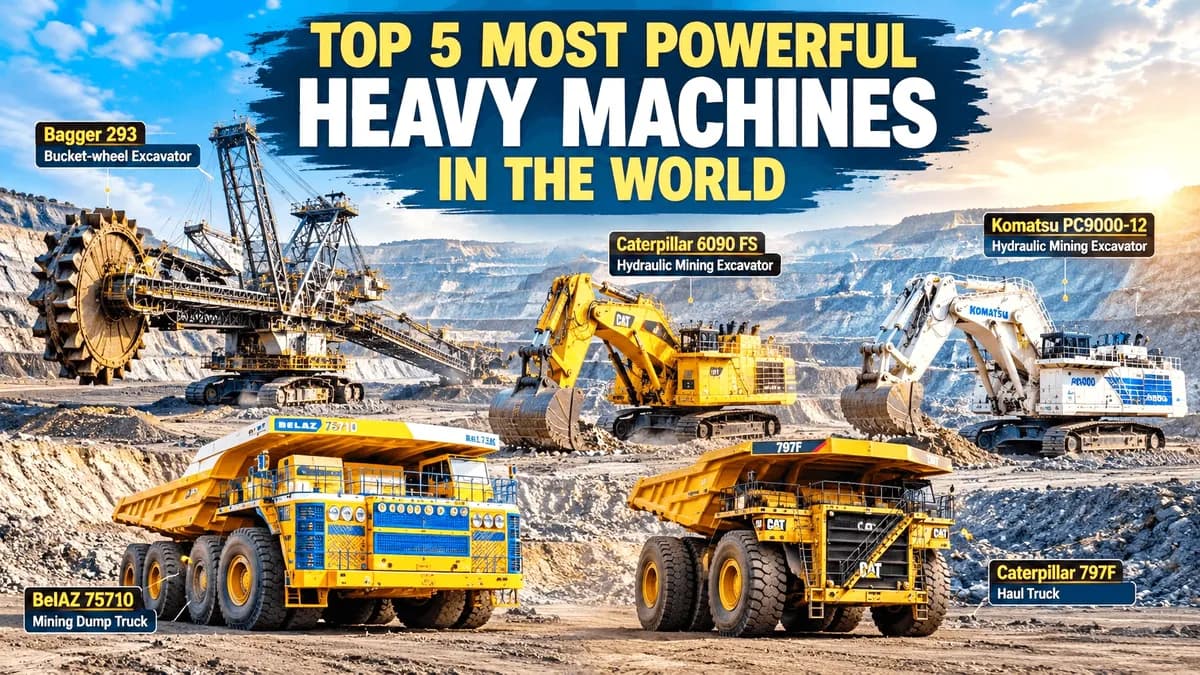
Top 5 most powerful heavy machines in the world - most useful vehicles in life
5 Most Powerful Heavy Machines in the World
Heavy machinery plays a crucial role in modern construction, mining, and large-scale infrastructure development. From massive excavators that dig through solid rock to mining trucks capable of transporting hundreds of tonnes of material, these engineering giants demonstrate the incredible capabilities of modern technology. The world's most powerful heavy machines are designed to handle demanding tasks that ordinary equipment cannot perform efficiently.
These machines are used in mining operations, quarrying, earthmoving, and major industrial projects. Their enormous size, high engine power, and exceptional material-handling capacity make them essential for improving productivity and reducing project completion times. In this article, we explore the top 5 most powerful heavy machines in the world, including their specifications, key features, and practical applications.
1. Bagger 293 – One of the Largest Land Machines Ever Built
The Bagger 293 is one of the most impressive machines ever constructed. Manufactured by the German company TAKRAF, this giant bucket-wheel excavator is designed for large-scale surface mining operations. Its extraordinary dimensions and continuous excavation system make it a remarkable example of heavy engineering.
The machine is approximately 96 metres tall and 225 metres long. It weighs around 14,200 tonnes and uses a rotating wheel fitted with multiple buckets to remove large quantities of overburden and excavated material. Conveyor systems transport the material away from the excavation area, allowing mining operations to continue efficiently.
Unlike conventional excavators, the Bagger 293 does not rely on a single bucket attached to a hydraulic arm. Instead, its enormous rotating wheel continuously cuts into the ground. This design allows it to move substantial volumes of material during extended mining operations.
Key Features of the Bagger 293
- Approximate length of 225 metres.
- Height of approximately 96 metres.
- Operating weight of around 14,200 tonnes.
- Continuous excavation using a bucket-wheel system.
- Integrated conveyor systems for material transportation.
The Bagger 293 is primarily used in large open-pit mining operations rather than ordinary construction projects. Its enormous size makes it unsuitable for conventional building sites, but it demonstrates how specialized heavy machinery can transform industrial excavation.
Learn more about TAKRAF mining and material-handling technology.
2. Caterpillar 6090 FS – A Giant Hydraulic Mining Excavator
The Caterpillar 6090 FS is one of the world's largest hydraulic mining excavators. Designed for demanding mining environments, this machine combines enormous digging capacity with powerful engines and a heavy-duty structure. It is built to remove large quantities of earth and rock while loading mining trucks efficiently.
The 6090 FS has an operating weight of approximately 1,000 tonnes, depending on its configuration. It can produce around 4,500 horsepower and features a bucket capacity of approximately 52 cubic metres in its face-shovel configuration. These capabilities allow it to load large mining trucks in relatively few passes.
Its powerful hydraulic systems enable the machine to penetrate difficult materials, lift heavy loads, and operate during demanding mining cycles. The spacious operator cabin, monitoring systems, and machine-control features also help support productivity and operational safety.
Key Features of the Caterpillar 6090 FS
- Operating weight of approximately 1,000 tonnes.
- Engine power of around 4,500 horsepower.
- Face-shovel bucket capacity of approximately 52 cubic metres.
- Heavy-duty hydraulic digging and loading systems.
- Designed for large-scale surface mining operations.
The Caterpillar 6090 FS is particularly useful in mines where large volumes of material must be excavated and transferred to haul trucks. Its combination of digging force, bucket capacity, and engine power makes it a leading machine in the ultra-class excavator category.
For more technical information, visit the official Caterpillar website.
3. Komatsu PC9000-12 – An Ultra-Class Mining Excavator
The Komatsu PC9000-12 is an advanced hydraulic mining excavator developed for some of the world's largest mining operations. Introduced globally in 2026, it represents a new generation of heavy equipment designed to move enormous quantities of material while supporting efficient mining operations.
Depending on its configuration, the PC9000-12 has a reported operating weight of approximately 884 to 896 tonnes. Its power system can deliver around 4,500 horsepower, and it is available with diesel or electric drive options. The machine can be configured with a backhoe bucket of approximately 49 cubic metres or a face shovel of approximately 46 cubic metres.
Its large bucket capacity allows operators to load heavy-duty mining trucks efficiently. The excavator is engineered for demanding applications where consistent performance, machine availability, and high material throughput are important.
Key Features of the Komatsu PC9000-12
- Operating weight of approximately 884 to 896 tonnes.
- Combined engine output of around 4,500 horsepower.
- Bucket capacity of up to approximately 49 cubic metres.
- Diesel and electric drive configurations.
- Designed for high-volume mining and excavation.
The PC9000-12 is especially valuable in large open-pit mines, where excavation equipment must operate alongside ultra-class haul trucks. Its powerful drive system and substantial bucket capacity help mining companies move more material with fewer loading cycles.
Explore more equipment details on the official Komatsu website.
4. BelAZ 75710 – One of the World's Largest Mining Dump Trucks
The BelAZ 75710 is a giant mining dump truck developed by the Belarusian manufacturer BelAZ. It is widely recognized for its exceptional payload capacity and enormous dimensions. Unlike excavators that dig and load materials, this machine is designed to transport massive quantities of rock, ore, and other mined materials across large mining sites.
The BelAZ 75710 has a published payload capacity of up to 450 metric tonnes, with some sources reporting a maximum of 496 tonnes under specified conditions. Its gross operating weight can exceed 800 tonnes, depending on the configuration and load. The truck uses eight large tyres and a specialized drive system to support heavy-duty operation.
Its size and carrying capacity make it particularly suitable for large open-pit mines, where moving material over long distances is a major part of daily operations. The truck works most effectively when paired with large mining excavators capable of filling its enormous body efficiently.
Key Features of the BelAZ 75710
- Published payload capacity of up to 450 metric tonnes, with higher figures reported for specific configurations.
- Eight large tyres designed for heavy mining applications.
- Specialized diesel-electric drive technology.
- Designed for transporting heavy loads in open-pit mines.
- Large-capacity body for rock, ore, and excavated materials.
The BelAZ 75710 demonstrates the importance of transport capacity in modern mining. Even the most powerful excavator cannot deliver maximum productivity if trucks cannot move the excavated material away quickly enough. High-capacity haul trucks help maintain the flow of material throughout the operation.
Learn more about heavy mining trucks through the official BelAZ website.
5. Caterpillar 797F – A Powerful Ultra-Class Mining Truck
The Caterpillar 797F is another remarkable machine used in large-scale mining operations. It is a heavy-duty off-highway truck designed to transport massive loads of minerals, rocks, and overburden. Its powerful engine, robust frame, and advanced braking systems help it operate in demanding mining environments.
The Caterpillar 797F has a nominal rated payload capacity of 363 metric tonnes and a gross machine weight of approximately 623,690 kilograms. Its engine produces up to 4,000 horsepower, making it one of the most powerful conventional mining trucks in its class.
The truck is designed for high productivity in large mines, where reliable transportation is essential. Its powertrain supports heavy loads on mining haul roads, while its braking and retarding systems help operators maintain control on suitable gradients.
Key Features of the Caterpillar 797F
- Rated payload capacity of 363 metric tonnes.
- Gross machine weight of approximately 623.7 tonnes.
- Engine output of up to 4,000 horsepower.
- Heavy-duty chassis and mining-specific body design.
- Advanced braking and machine-monitoring features.
The 797F is commonly used in large mining operations where heavy materials must be transported continuously. When matched with the appropriate excavators, it helps improve loading efficiency and maintain a steady material supply for processing facilities.
For official specifications, visit the Caterpillar 797F product page.
Comparison of the Top 5 Most Powerful Heavy Machines
| Machine | Type | Approximate Weight | Main Application |
|---|---|---|---|
| Bagger 293 | Bucket-wheel excavator | 14,200 tonnes | Large-scale surface mining |
| Caterpillar 6090 FS | Hydraulic mining excavator | 1,000 tonnes | Excavation and truck loading |
| Komatsu PC9000-12 | Hydraulic mining excavator | 884–896 tonnes | High-volume excavation |
| BelAZ 75710 | Mining dump truck | Over 800 tonnes at gross weight, depending on configuration | Heavy material transportation |
| Caterpillar 797F | Off-highway mining truck | 623.7 tonnes at gross machine weight | Mining material transportation |
Note: This comparison highlights machines with different functions and performance measures. It is not a definitive ranking of horsepower alone. Operating weight, payload capacity, excavation capability, and engine power are different specifications, so the figures should not be compared as equivalent measurements.
Why Are Powerful Heavy Machines Important?
Powerful heavy machinery is essential for completing large-scale industrial and infrastructure projects efficiently. These machines can move huge quantities of material, perform demanding tasks, and reduce the time required for operations that would otherwise require extensive manual effort.
In mining, high-capacity excavators and haul trucks help improve material production and transportation. In major earthmoving projects, specialized machines support excavation, site preparation, and the movement of soil and rock. Their use can also reduce the amount of manual handling required for physically demanding work.
However, purchasing and operating these machines involves significant expenses. Fuel or electricity consumption, maintenance, replacement parts, operator training, and transportation must all be considered. Companies should select equipment according to project requirements instead of choosing machinery based on size or power alone.
Regular inspections, preventive maintenance, trained operators, and proper safety procedures are essential for reliable operation. Businesses can also use fleet-monitoring technology to track operating hours, fuel consumption, machine health, and maintenance schedules.
For related information, read our guides on heavy construction machinery, different types of excavators, and construction equipment maintenance.
Conclusion
The world's most powerful heavy machines represent extraordinary achievements in engineering and industrial technology. The Bagger 293 stands out for its enormous size and continuous excavation capabilities, while the Caterpillar 6090 FS and Komatsu PC9000-12 are designed for high-volume mining operations. Meanwhile, the BelAZ 75710 and Caterpillar 797F demonstrate the importance of powerful, high-capacity transportation equipment.
Each machine has a specific purpose, and its effectiveness depends on the requirements of the operation. By choosing suitable equipment, maintaining machinery properly, and following safe operating practices, mining and construction companies can improve productivity and manage demanding projects more efficiently.
As heavy equipment technology continues to advance, improvements in automation, energy efficiency, electric drive systems, and digital monitoring are likely to shape the next generation of industrial machinery.